
168 BC
The Mawangdui tomb in Changsha is sealed; it will be excavated in 1973. A silk manuscript, “Recipes for 52 Ailments”, records 以小角角之 — “apply a small horn”. It's the oldest Chinese record of cupping. (Mawangdui)
A horn from a Chinese tomb, a Roman doctor's electric ray and the world's first laser — 2,200 years of history in one white box
In brief
The Magic FoHerb 3.0 bio-energy massager does cupping — the very cups whose purple marks the whole world spotted on Michael Phelps’s back in 2016. The device is made at the Fohow group’s plant in Tianjin and sold by WHIEDA, and in chats people simply call it the BEM. It’s the heir to the “Fohow suitcase”, a bio-energy massager that has been on sale for about twenty years. In one box: cups and heated gua sha, an impulse along the meridians through the palms, and a red laser. An evening, fifteen minutes on the neck and shoulders, and your back finally lets go of the working day.
Rio's Olympic pool, the 4×100 metre freestyle relay. Phelps takes off his jacket, and the cameras catch neat purple circles on his shoulders. Social media wonders: tattoos? Crop circles? A symptom of the Zika virus? A few minutes later Phelps wins his 19th Olympic gold, and the world learns a new word: cupping (Irish Times).
That's how much searches for “circles on Michael Phelps” grew that day, according to Google Trends. For a while, people searched for the phrase more often than for “Olympic medals”.
Other Americans in Rio wore the circles too: swimmer Natalie Coughlin and gymnast Alex Naddour. Basketball star Shaquille O'Neal, NFL player DeMarcus Ware and tennis player Ben Shelton use cupping to recover (Wikipedia).
Celebrities came to cupping before athletes did. Gwyneth Paltrow arrived at a premiere in a backless dress, and on her back were round marks. NPR devoted an entire segment to them (NPR).
Athletes didn't invent cupping — they brought it back. In ancient China the procedure was called “the horn” — 角法 — and a real animal horn was used (Wikipedia).
168 BC
The Mawangdui tomb in Changsha is sealed; it will be excavated in 1973. A silk manuscript, “Recipes for 52 Ailments”, records 以小角角之 — “apply a small horn”. It's the oldest Chinese record of cupping. (Mawangdui)
5th–4th centuries BC
In Greece, Hippocrates practises cupping.
4th century
Taoist, alchemist and herbalist Ge Hong (281–341) is the first cupping master China knows by name. In his handbook of emergency remedies, the horn is already an ox horn.
6th–10th centuries
In the Sui and Tang eras, the horn gives way to a bamboo cup. Bamboo cups are still sold from street stalls in Haikou today.
15th century
In Finland, cupping is done in the sauna. The Finnish horn has a clever trick: a valve inside for sucking out the air. A vacuum cup — five hundred years ago.
1950s
Cupping enters Chinese hospitals as an official method of Chinese medicine. (Wikipedia)
That's how long it's been from the Mawangdui tomb to 2026: 168 + 2026 − 1 = 2,193. We subtract one because the calendar has no year zero.
Cupping has a sister — gua sha, 刮痧. 刮 means “to scrape”, and 痧 means the red dots that appear on the skin after the procedure. As a method of Chinese medicine, gua sha was described in the Ming era (1368–1644). People scraped with whatever was at hand: a spoon, a coin, jade, a plate of horn (Wikipedia).
In 2001 a film was made about it — “Gua Sha”, directed by Zheng Xiaolong and starring Tony Leung Ka-fai. A grandfather comes from China to visit his son in St. Louis. His grandson has a fever; the grandfather can't read the English labels on the medicine, so he gives the boy gua sha. Social services see the stripes on the boy's back, decide he is being beaten and take him from the family. The resolution comes from a family friend, a lawyer: he does gua sha on himself and shows that the marks look frightening but don't hurt (Wikipedia).
The goal of the procedure is warmth and lightness; the mark has nothing to do with it. The Magic FoHerb manual says the same: a bright red mark is a cue to lower the vacuum and shorten the time.
For two thousand years, cupping needed a master: to handle the fire, heat the glass and make sure the skin didn't get burned. In Magic FoHerb 3.0, a single attachment does both cupping and gua sha. It suctions onto the skin, and you choose the vacuum strength and the heat with a button.
With whatHorn, bamboo, glass
VacuumFire, or air drawn out through a valve
HeatFrom fire
Gua shaCoin, spoon, jade
WhereAt a clinic, by appointment
With whatOne attachment for cupping and gua sha
Vacuum5 levels, at the press of a button
HeatHeating, 5 levels
Gua shaThe same attachment, along the massage line
WhereAt home, whenever suits you
In Moscow, a cupping session at a clinic usually costs 2–3 thousand rubles. On 12 October 2026 the aggregator NaPopravku listed 240 clinics, with prices from 500 to 10,500 ₽ per session (NaPopravku). One device at home serves the whole family: your face, your husband's back, your mum's shoulders.
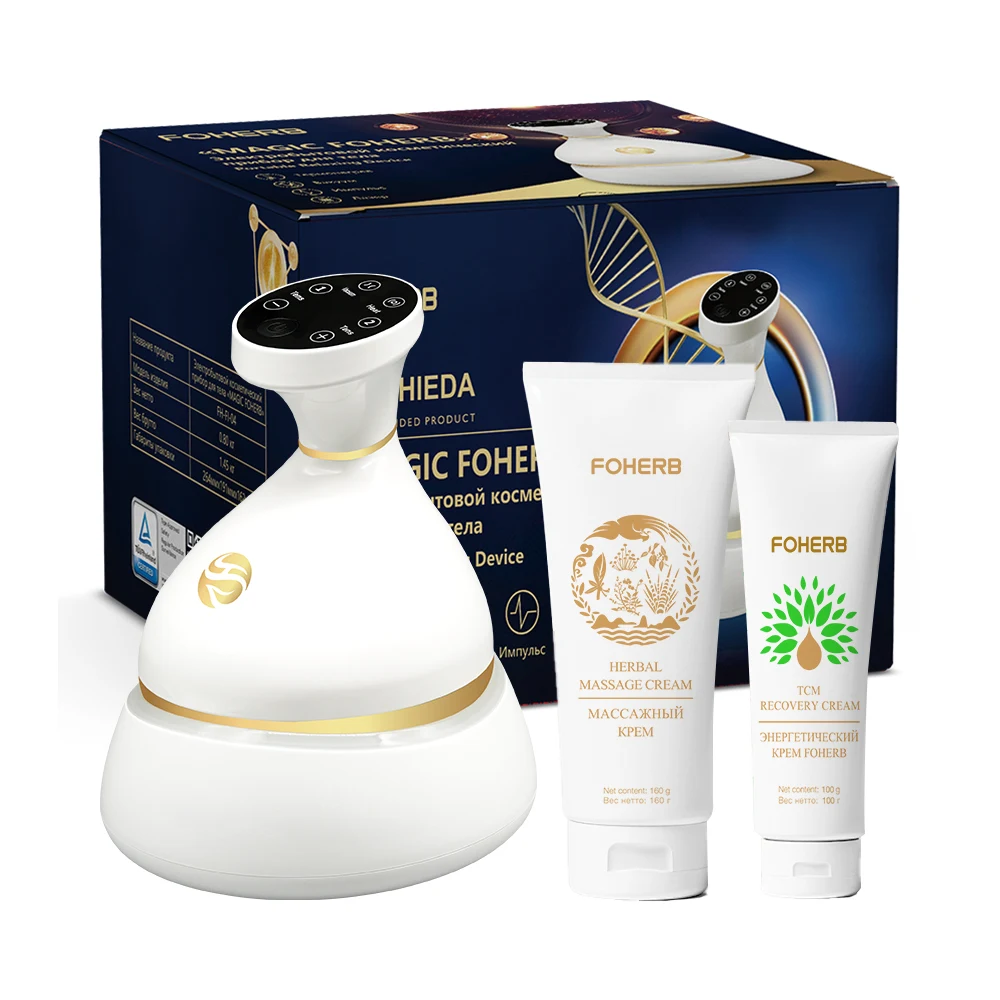
Impulse · 99 levels
It travels through gloves: the palms of the person giving the massage carry it along the back. The current is direct, gentler than in the Fohow suitcase. The strength is set by how it feels to the person lying down.
Vacuum · 5 levels
Cupping on a point, gua sha along a line.
Heating · 5 levels
Warmth makes the vacuum gentler, so they're switched on together.
Laser · 650 nm
Red, two modes, up to 30 minutes. It's used to warm the nose, ears and throat.
Battery
The device runs on a built-in battery, so you don't need a socket during the massage.
Gloves
Two pairs: dry insulating gloves on the hands, damp conductive ones on top. The impulse goes exactly where the palm rests.
Two herbal creams
The massage cream has wormwood, lovage and hyaluronic acid, and lets the attachment glide. The energy cream has ginseng, ginger and eleuthero, and is rubbed in at the end.
Cupping is half the device. The other half is the impulse, and its story is just as long.
Around AD 47
Scribonius Largus, court physician to Emperor Claudius, compiles a book of 271 recipes. For headaches and gout he recommends an electric ray: stand on the live fish right at the seashore. (Scribonius Largus, history of TENS)
1780
Italian physician Luigi Galvani sees a dead frog's leg twitch from an electric spark. In 1791 he writes about “animal electricity”: muscles and nerves run on their own current. Bioelectricity begins with this frog. (Galvani)
1974
The first wearable TENS device is patented in the US: electrodes are stuck to the skin, and the impulse passes through them.
A study of the principle, not the finished device. Why do we rub a bumped elbow? Ronald Melzack and Patrick Wall answered that in the journal Science. Signals from touch close a “gate” in the spinal cord to the pain signal. Their gate control theory became the basis for TENS devices (PubMed, Wikipedia).
Magic FoHerb has a big brother. For about twenty years Fohow has been selling a bio-energy massager in a little suitcase, and in chats that’s exactly what people call it: the “Fohow suitcase”. Long-time partners remember a handsome leather case: they took it on trips along with the rest of their luggage, and as they recall, it weighed about six kilograms.
Over twenty years the suitcase has built up a great many results in people. Magic FoHerb 3.0 grew out of that experience. The idea is the same: an impulse through gloved palms. But the suitcase runs on alternating current, while Magic FoHerb uses direct current, and the effect has become gentler. The device now fits in a bag and runs on a battery.
On the marketAbout 20 years
CurrentAlternating
Power supplyMains-powered, 220 V
FormatLeather case
On the marketNew generation
CurrentDirect, gentler effect
Power supplyBuilt-in battery
FormatCompact white device
That’s how long the Fohow suitcase has been on sale. Twenty years of experience now fit into a compact direct-current device: gentler for the person lying down and lighter for the person carrying it.
In Chinese medicine the body has 12 main meridians — channels through which Qi flows. Count the unique points on them and you get 361, almost the number of days in a lunar-calendar year. Most points come in pairs, so the body has 670 in all (Wikipedia).
The points may be more than five thousand years old. Ötzi, the Iceman found in the Alps in 1991, has 61 tattoos on his body. Scientists noticed that many of them sit where acupuncturists place needles for lower back and abdominal pain. One hypothesis says they are traces of ancient treatment. And Ötzi lived two thousand years before acupuncture appeared in China (Wikipedia).
Acupuncture and moxibustion of traditional Chinese medicine were inscribed on the Representative List of the Intangible Cultural Heritage of Humanity (UNESCO).
A wearable TENS is stuck to the skin and left there. With Magic FoHerb, the impulse travels through the palms of a person wearing gloves. The palms stroke, knead, pause on a point and guide the impulse along the meridians: from the base of the neck down to the sacrum, along the spine and the two lines beside it. Rubbing and point work in a single movement — without a single needle.
This is how the Nodar Gazneli method works. He is a massage master and the author of the BEM method taught in the WHIEDA community. In his words, he studied acupuncture with the Frenchman Maurice Mussat (1923–2017), author of the book “Énergétique physiologique de l'acupuncture” (catalogue of the National Library of France). He guides the impulse from top to bottom, following the flow of energy. Then, Gazneli says, after the session a person will “want to take flight”. His master class is free to watch on YouTube (video).
On 16 May 1960, Theodore Maiman switched on the first laser at the Hughes laboratory. A ruby rod produced a deep red beam with a wavelength of 694 nanometres (Wikipedia). The Magic FoHerb laser shines in the same red range — 650 nm.
Seven years later, Hungarian surgeon Endre Mester was repeating someone else's experiment on mice. His laser turned out weaker than needed, and the result was unexpected: on the shaved patches of the irradiated mice, the fur grew back faster. Mester called it “laser biostimulation”. In 1974 he opened the Laser Research Centre at Semmelweis University in Budapest (Wikipedia).
Everyone at home has their own spot: your face, your husband's back, your mum's shoulders after a day in the garden.
Just for you: face and contour
The attachment glides along the face's massage lines with massage cream, on the gentlest setting. After the session your skin is soft and smooth. Gua sha on the thighs — against cellulite.
Just for you: neck and shoulders
Heated cups on the points while you watch your favourite series.
For two: the back
The one giving the massage puts on the gloves, and you lie down. Then you swap.
For lovers of cupping and gua sha
Familiar procedures, with warmth from a heater instead of fire.
By evening she longed for someone to “tap” her back. After the first time she wrote: “One BEM session — and such lightness.” Now they have their own “family evening ritual” at home.
More stories on reviews page.
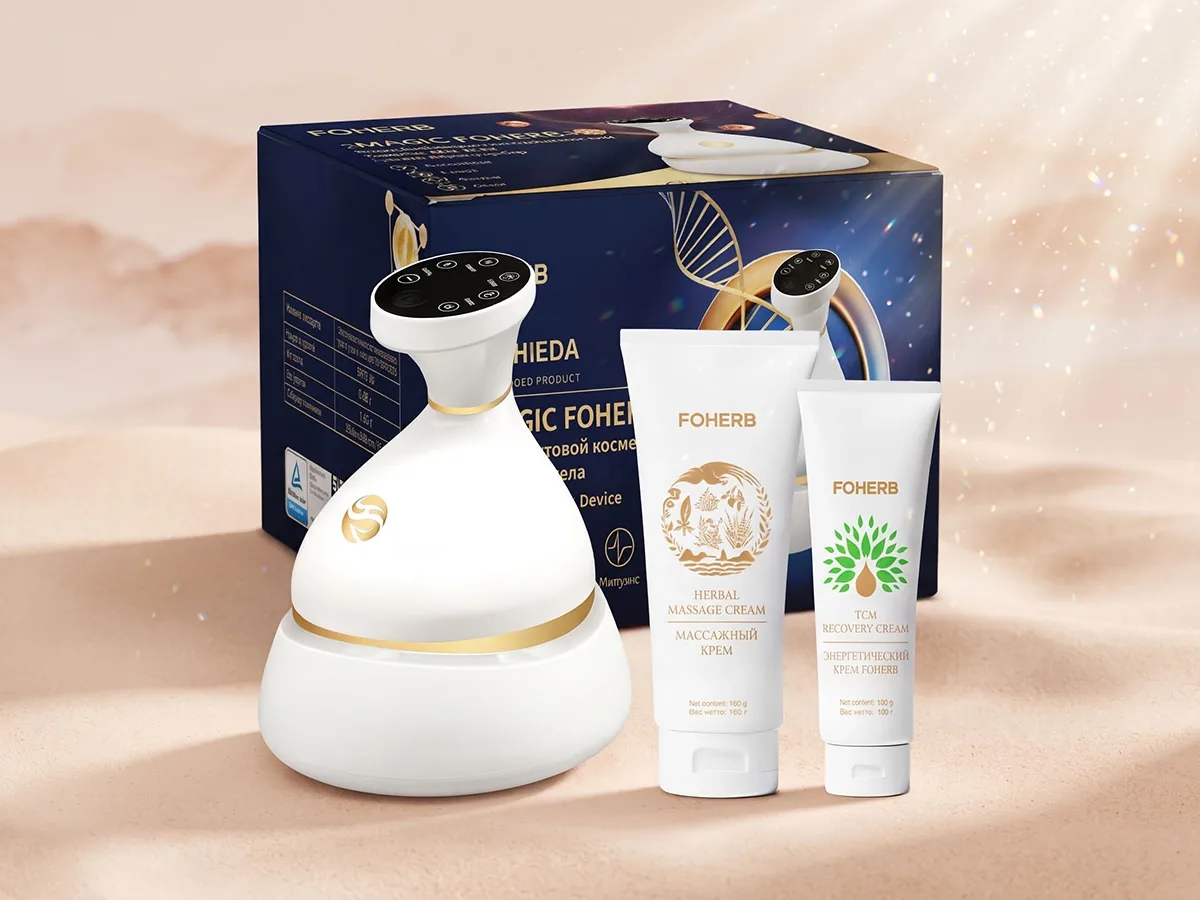
No fire, alcohol, glass or appointment with a master needed. Just fifteen minutes and some cream.
Charge it
Charge the battery fully before the session.
Cream
Massage cream only: oil damages the pump.
Gloves
Dry insulating gloves on the hands, conductive ones on top, soaked through, metal snaps included. Start the impulse at the weakest level.
Back
Palms flat, slowly and without stopping, from the base of the neck to the sacrum. One zone takes 10–15 minutes.
Cupping and gua sha
For cupping, set heat to level four and vacuum to 4 or 5; the cup stays on a point for 3–5 minutes. For gua sha, the same heat, vacuum level two, 20 passes along the line.
Finish
Energy cream applied clockwise, with cling film on top — the warmth lasts longer.
Hand technique is also demonstrated, free of charge, in Safura Yergaliyeva’s course.
Metal and electronics in the body: pacemaker, insulin pump, metal implants. With an IUD it's allowed three months after insertion, with dental implants six months after, but the face is not treated. Pregnancy, menstruation, age under 10. Cancer, epilepsy, active tuberculosis. Acute conditions and thrombosis, bleeding, the first six months after surgery. Skin infections. With severe varicose veins, the legs are not massaged.
KG 417/043.CN.02.00950EAEU certificate
MAGIC FOHERB body massage device, model FH-FI-04: a household appliance for self-use. Complies with the Customs Union technical regulations on the safety of low-voltage equipment and on electromagnetic compatibility. Valid until 27 November 2028. Open certificate ↗
TianjinPlant
The device is assembled at a plant in the Huaming High-Tech Zone, Dongli District. The manufacturer's address on the certificate — No. 16 Hengsheng Avenue — is the address of the group's science and technology company. It was founded in 2019 with registered capital of 100 million yuan. Plant page ↗ · about the company ↗
Д-CN.РА08.В.35231/22Massage cream
EAEU declaration, cosmetics, valid until 17 November 2027. Open declaration ↗
Д-CN.РА08.В.84199/22Energy cream
EAEU declaration, cosmetics, valid until 5 December 2027. Open declaration ↗
Who's who: Fohow and FOHERB are the group and the brand on the box, Tianjin Fohoway Technology Development is its device plant in Tianjin, and WHIEDA sells the device in Russia and the CIS.
Will I get circles like Phelps?
After cupping on a strong vacuum, you might: the mark depends on the level, the time on the point and your skin. Leaving a mark isn't the goal. If it's bright, lower the vacuum and shorten the time.
Can I give myself a massage?
Yes: cupping, gua sha, face and laser you can do on yourself. The impulse through the gloves is for two: one gives the massage, the other lies down.
How is the BEM different from a marketplace massager?
An ordinary massager vibrates on its own. With Magic FoHerb, living hands do the massage, and the device adds impulse, vacuum, warmth and red light to them. The box also includes two herbal creams.
How is Magic FoHerb different from the Fohow suitcase?
The Fohow suitcase has been on sale for about 20 years and runs on alternating current from a wall socket. Magic FoHerb uses direct current with a gentler effect, runs on a battery, and the device itself is compact. Housed together with the impulse: cups, heated gua sha and a red laser.
When will I feel the difference?
Dinara from Astana felt lightness after the very first session. Now they keep a rhythm: gua sha is repeated every 7–10 days, and the impulse is done as a course.
A horn from the Mawangdui tomb, Tang-dynasty bamboo, a Finnish cup with a valve, Meiman’s red light and twenty years of the Fohow suitcase: now it’s all one attachment, a pair of gloves and a button.
Magic FoHerb 3.0 costs 65,000 ₽ — the same as 22 cupping sessions at 3,000 ₽ in a Moscow clinic. Availability, prices for other countries and videos are on the device's product page.